
Nordstone Team
Professional Writers
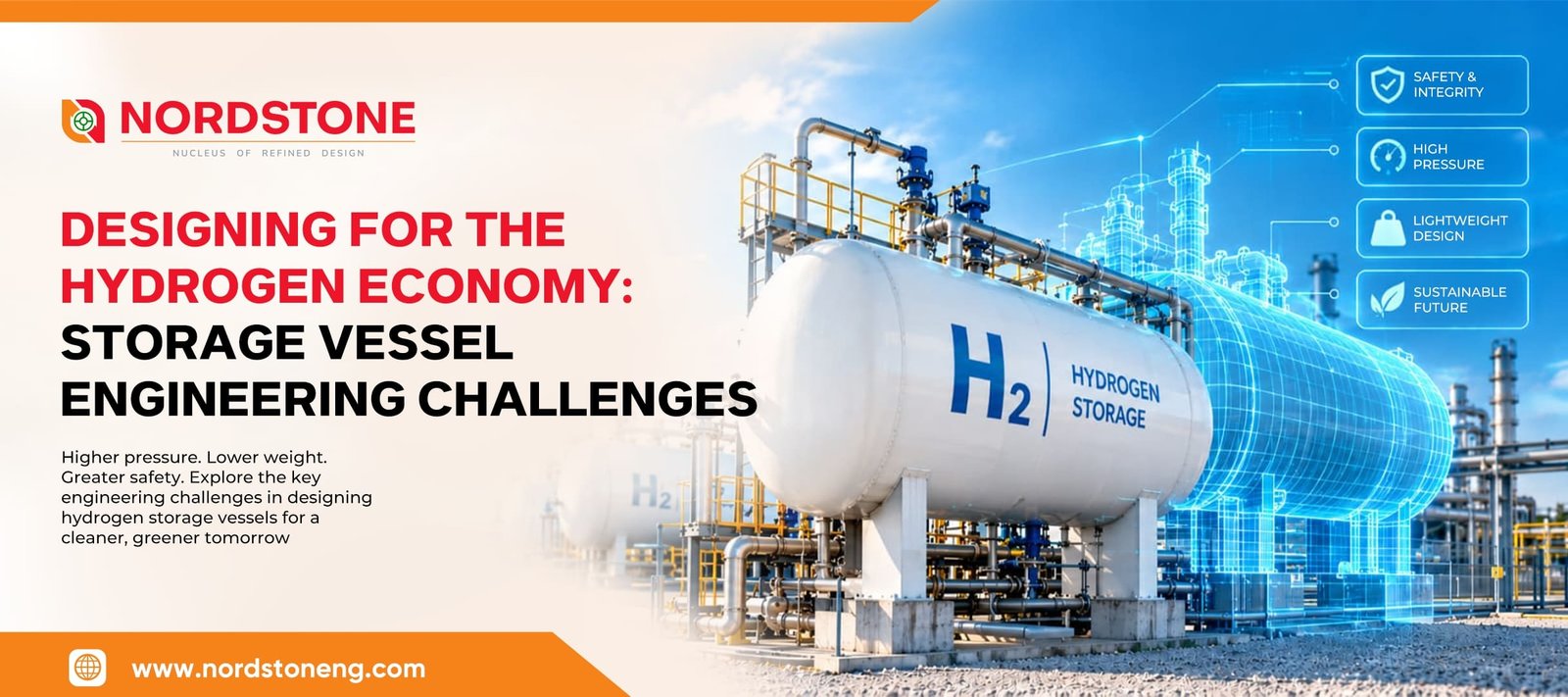
Designing for the Hydrogen Economy: Storage Vessel Engineering Challenges
Introduction: Engineering for a Hydrogen-Powered Future
Hydrogen is attracting increasing attention as an energy carrier for industrial processes, transportation, energy storage, and applications that are difficult to electrify directly. As hydrogen infrastructure expands, reliable storage systems are becoming an important part of the energy transition.
However, storing hydrogen presents unique engineering challenges. Its small molecular size, wide flammability range, and potential effects on certain structural materials require careful consideration during vessel design, fabrication, inspection, and operation.
Hydrogen storage vessels must be designed around their intended pressure, temperature, storage method, operating cycles, materials, and service environment. A successful design balances performance, structural integrity, safety, manufacturability, and lifecycle cost.
Understanding Hydrogen Storage Technologies
Hydrogen can be stored in different forms depending on the application, required capacity, delivery method, and operating conditions. Each approach introduces distinct design and material requirements.
Compressed Hydrogen
Hydrogen is stored as a compressed gas in purpose-designed pressure vessels. High pressure places significant demands on wall thickness, fatigue resistance, connections, and material compatibility.
Liquid Hydrogen
Cryogenic storage requires extremely low temperatures, suitable insulation, thermal management, and careful control of heat ingress and boil-off.
Material-Based Storage
Certain systems store hydrogen through absorption or chemical carriers. Their vessel requirements depend on the storage medium, temperature, pressure, and associated process conditions.
Key Engineering Challenges in Hydrogen Storage Vessels
Hydrogen storage vessel engineering requires a coordinated approach to pressure containment, material selection, fatigue assessment, manufacturing quality, and operating safety. The most appropriate solution depends on the intended application and design conditions.
High-Pressure Design and Structural Integrity
Compressed hydrogen storage systems may operate at high pressures, requiring careful evaluation of shell thickness, geometry, stress concentrations, nozzle connections, closures, and support arrangements. Engineering calculations and appropriate analysis methods help verify that the vessel satisfies its design requirements.
Hydrogen Embrittlement and Material Compatibility
Hydrogen can enter certain metals and reduce their resistance to cracking under susceptible material, stress, and environmental conditions. Material selection must consider hydrogen compatibility, strength, toughness, manufacturing history, weld characteristics, and the intended pressure and temperature range.
Fatigue and Repeated Pressure Cycles
Hydrogen storage vessels may experience repeated filling, discharge, and pressure fluctuations. These cycles can contribute to fatigue damage, especially near welds, openings, and other stress concentration points. Design life assessments should account for the expected duty cycle and applicable fatigue criteria.
Welding and Manufacturing Quality
Fabrication processes can influence material properties and structural reliability. Qualified welding procedures, appropriate heat treatment where required, material traceability, dimensional verification, and non-destructive examination are important elements of manufacturing quality assurance.
Leakage Prevention and Operational Safety
Hydrogen's small molecular size makes leakage prevention an important consideration. Seals, valves, fittings, instruments, piping interfaces, and vessel connections must be suitable for the intended hydrogen service. Ventilation, detection, isolation, and emergency response measures should be incorporated into the overall system design.
Thermal Management and Cryogenic Conditions
Liquid hydrogen storage introduces additional challenges involving thermal contraction, insulation performance, material behaviour at cryogenic temperatures, and heat transfer. Engineers must account for thermal stresses and the effects of temperature changes on connected equipment and containment systems.
Material Selection for Hydrogen Pressure Vessels
Material selection is a fundamental part of hydrogen vessel engineering. Materials that perform well in conventional pressure service may not automatically be suitable for every hydrogen application. Suitability depends on the material grade, strength, microstructure, fabrication method, operating pressure, temperature, and hydrogen exposure.
| Material Category | Engineering Considerations |
|---|---|
| Carbon and Low-Alloy Steels | Strength, toughness, hydrogen compatibility, hardness, weld properties, and fracture resistance. |
| Stainless Steels | Grade-specific compatibility, strength, temperature limits, fabrication, and service environment. |
| Composite Materials | Fibre architecture, liner performance, permeability, impact damage, fatigue, and manufacturing quality. |
| Cryogenic Materials | Low-temperature toughness, thermal contraction, insulation, and thermal cycling performance. |
Final material selection should be supported by applicable design codes, material qualification data, hydrogen service requirements, and engineering assessment rather than by material category alone.
The Role of CAD, FEA, and Engineering Simulation
Computer-aided design and finite element analysis (FEA) support the development and evaluation of hydrogen storage vessels. CAD models define the vessel geometry, while engineering simulations help investigate stresses, deformations, local discontinuities, and selected operating or loading scenarios.
CAD-Based Design Development
Create detailed vessel models, evaluate nozzle arrangements, coordinate connected systems, and prepare engineering information for manufacturing and design review.
Finite Element Analysis
Evaluate stress distribution, deformation, local stress concentrations, and relevant load combinations using suitable material properties, boundary conditions, and validated analysis methods.
Fatigue and Fracture Assessment
Investigate cyclic loading and potential crack-related concerns using applicable assessment procedures and material data suitable for the intended hydrogen service.
Design Optimisation
Compare design alternatives to balance structural performance, weight, manufacturability, inspection access, and lifecycle requirements while maintaining applicable code compliance.
Codes, Standards, and Regulatory Compliance
Hydrogen storage systems must be designed and qualified according to the codes, standards, and regulatory requirements applicable to their type, operating conditions, and location.
Depending on the application, relevant references may include the ASME Boiler and Pressure Vessel Code, standards for transportable gas cylinders and composite vessels, hydrogen service material guidance, and local pressure equipment regulations.
Engineers should verify the current applicable edition, scope, jurisdictional requirements, and any additional qualification requirements before selecting a design or fabrication route. Compliance with a general pressure vessel code alone does not automatically establish suitability for every hydrogen service.
The Future of Hydrogen Storage Vessel Engineering
Advances in composite manufacturing, material science, engineering simulation, digital twins, and condition monitoring are creating opportunities to improve hydrogen storage system development. Connected engineering data can support design verification, manufacturing traceability, inspection planning, and lifecycle performance assessment.
As hydrogen infrastructure grows, engineering teams will need to combine innovative storage technologies with rigorous design validation, appropriate material qualification, manufacturing discipline, and robust safety management.
Building Safer and More Reliable Hydrogen Storage Systems
Designing for the hydrogen economy requires a comprehensive understanding of pressure containment, hydrogen-material interactions, fatigue, thermal conditions, manufacturing quality, and operational safety. Each factor must be evaluated in the context of the intended storage technology and service environment.
By combining sound engineering fundamentals, validated analysis, qualified materials, and applicable standards, organisations can develop hydrogen storage vessels that support reliable performance throughout their intended lifecycle.