Nordstone Team
Professional Writers
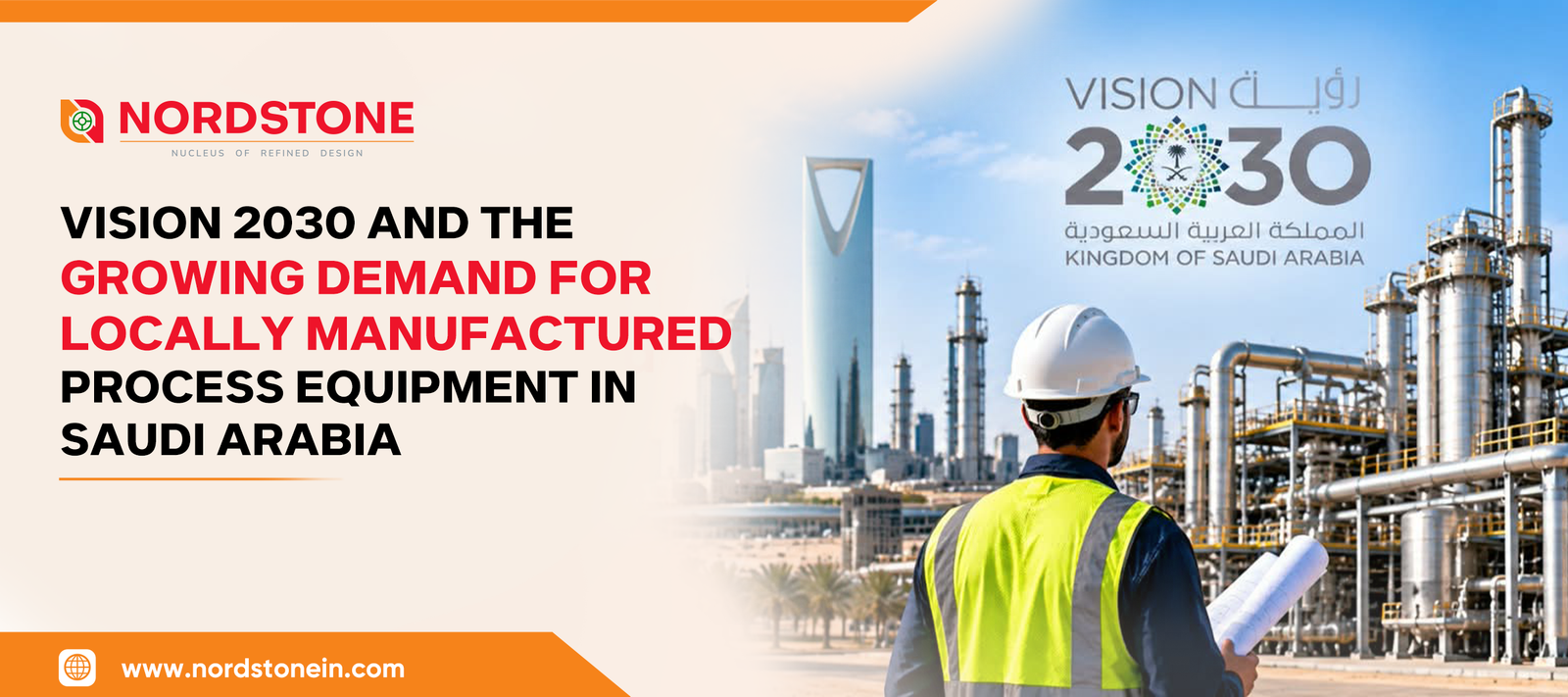
Vision 2030 and the Growing Demand for Locally Manufactured Process Equipment in Saudi Arabia
Introduction
Saudi Arabia's Vision 2030 has changed how industrial projects are planned, procured and delivered. One of its most visible effects is the growing emphasis on localisation: building manufacturing capability inside the Kingdom so that more of the goods and services used by energy, industrial and infrastructure projects are produced in Saudi Arabia. For owners, EPC contractors and equipment buyers, this has made local manufacturing capability a practical procurement consideration rather than a policy slogan.
Process equipment is a natural focus of this shift. Pressure vessels, heat exchangers, reactors, columns, storage tanks, process skids and boilers are used throughout oil and gas, petrochemicals, power, water, minerals and industrial facilities. They are engineered items with demanding codes, long lead times and significant logistics requirements, which makes the benefits of nearby manufacturing easy to see. This article explains why demand for locally manufactured process equipment is growing and what buyers should evaluate when selecting a Saudi-based manufacturer.
1. Why Localisation Sits at the Centre of Vision 2030
Vision 2030 aims to diversify the economy, expand the private sector and reduce dependence on imports. Local content is one of the main tools for achieving these goals because it keeps more project spending, skills and technology inside the Kingdom. The Local Content and Government Procurement Authority (LCGPA) plays a central role by bringing localisation efforts and government procurement policy together under one framework.
Large energy and utility buyers have also developed their own programmes. Saudi Aramco's iktva (In-Kingdom Total Value Add) programme is one well-known example. In February 2026, Aramco reported that iktva had reached its target of 70% local content in its supply chain and set a new goal of 75% by 2030. Other major buyers, including utilities and industrial companies, have likewise promoted local manufacturing within their procurement strategies. The direction is clear, although the specific rules and scoring methods differ between organisations and projects.
2. What This Means for Process Equipment Demand
When buyers are encouraged or required to consider local content, equipment that can be engineered, fabricated and tested in Saudi Arabia becomes more attractive. Process equipment is well suited to this approach because much of its value is created through design, fabrication, welding, inspection, testing and documentation, activities that can be carried out in-Kingdom.
Demand is also supported by the scale of industrial activity. Refining, petrochemicals, gas processing, power generation, water treatment, minerals processing and emerging areas such as hydrogen and carbon-capture projects all rely on pressure equipment and process packages. Not every project will have the same local content requirements, but the market direction favours capable domestic manufacturers.
3. Practical Benefits of Buying Locally Manufactured Equipment
Local manufacturing can offer several practical advantages when it is done to the right quality level:
- Shorter logistics chains. Large vessels and columns can be difficult to ship. Fabrication closer to the project site can reduce transport complexity, export-packing requirements and the risk of delays at ports or borders.
- Better engineering collaboration. Buyers, consultants and manufacturers can hold design reviews, fabrication meetings and inspection visits more easily when the shop is in the same country and time zone.
- Easier inspection access. Owner and third-party inspectors can attend witness and hold points more conveniently, which supports quality control during fabrication.
- Responsive after-sales support. Spare parts, modifications, repairs and technical clarifications can often be handled faster by a nearby team.
- Supply-chain resilience. Reducing dependence on distant suppliers can lower exposure to shipping disruptions and long international lead times, although raw materials may still be sourced globally.
- Alignment with local content goals. Domestic manufacturing may contribute to local content scoring, depending on the applicable programme and how its value is calculated.
These benefits depend on the manufacturer's actual capability. Being located in Saudi Arabia does not replace the need for qualified engineering, controlled fabrication and verified quality.
4. Local Does Not Mean Lower Standards
Locally manufactured equipment is still expected to meet the same technical requirements as imported equipment. Pressure vessels are commonly designed and stamped to ASME Boiler and Pressure Vessel Code Section VIII, heat exchangers to TEMA and applicable ASME requirements, storage tanks to standards such as API 650 or API 620 where specified, and project work to the owner's own specifications. Material traceability, qualified welding procedures, non-destructive testing and pressure testing remain essential.
Buyers should therefore evaluate local manufacturers with the same rigour they would apply to any international supplier. A credible manufacturer should be comfortable discussing its code authorisations, inspection plans, test records and project references.
5. What to Evaluate in a Saudi-Based Manufacturer
A structured assessment helps buyers separate capable manufacturers from those that only assemble or resell. Useful points to check include:
- Certifications and code authorisations. Confirm that ASME or other required code certificates are valid and cover the intended scope, along with management-system certificates such as ISO 9001, ISO 14001 and ISO 45001.
- Client and industry approvals. Check whether the manufacturer is approved or registered with the relevant end users, and whether the approval covers the equipment type, thickness range and materials involved.
- Engineering capability. Ask who performs design calculations, drawings and analysis, and how revisions and approvals are controlled.
- Workshop capacity. Review plate rolling, welding, machining, heat-treatment access, lifting capacity, blasting and painting facilities, and the physical size limits of what can be produced.
- Quality and inspection systems. Look for documented inspection and test plans, welding procedure and welder qualification records, NDT capability and clear non-conformance handling.
- Material sourcing and traceability. Understand where plates, tubes, forgings and fittings come from and how certificates are checked and traced to the finished item.
- Local content documentation. If local content scoring matters to the project, ask what evidence the manufacturer can provide and how it is calculated.
- Track record. Review comparable projects, delivery performance and references from similar industries.
6. Challenges That Still Need Careful Management
Localisation is a long-term effort, and buyers should be realistic about the challenges. Specialty materials, forgings and some components may still be imported. Skilled welders, inspectors and engineers are in high demand. Qualification of a new manufacturer by an end user can take time, so early engagement is important. Capacity can also be tight when many large projects run at the same time.
These issues do not weaken the case for local manufacturing, but they do mean that schedule, material availability and qualification should be discussed early. A transparent manufacturer will explain constraints rather than overpromise.
7. How Manufacturers and Buyers Can Work Together Early
The best outcomes usually come from early collaboration. Sharing process data, design basis, applicable specifications and project schedule at the enquiry stage allows the manufacturer to confirm feasibility, propose practical improvements and identify long-lead items. Early agreement on documentation requirements, inspection stages and acceptance criteria avoids confusion later.
For skid packages, integrated manufacturing can bring vessels, exchangers, piping, instrumentation and structural work under one coordinated scope. This can reduce interface risk and make factory testing more practical before equipment is delivered to site.
Conclusion
Vision 2030 has made localisation a lasting feature of the Saudi industrial landscape. For process equipment, that means growing interest in pressure vessels, heat exchangers, reactors, columns, tanks, skids and boilers that are designed, fabricated and tested inside the Kingdom. The advantages can include shorter logistics, easier inspection, stronger collaboration and support for local content objectives.
Those advantages are realised only when local manufacturers meet the technical, quality and documentation standards that projects require. Buyers who evaluate certifications, approvals, workshop capability, traceability and track record are well placed to choose partners that can deliver safe, compliant and dependable equipment. Nordstone designs and manufactures pressure vessels, heat exchangers, reactors, columns, storage tanks, process skids, boilers and related equipment in Saudi Arabia, working to international codes such as ASME, TEMA and API under ISO-certified management systems.